


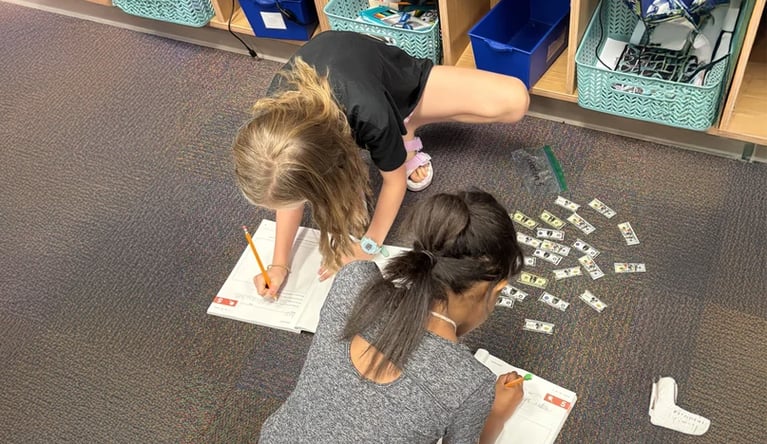
It can be difficult for a school district to see large achievement gains the first year of implementing a new math curriculum, particularly when that comes with big instructional shifts. But for schools in Bentonville, Arkansas, the first year using Eureka Math²® was a resounding success.
Students in grades K-4 used the curriculum during the 2024-2025 school year. Students in third and fourth grades are among those who take end-of-year state tests, and their proficiency rates on the Arkansas math assessment grew by nearly 9 percentage points, going from 59.1% to 68% scoring at the proficient level on the ATLAS math assessment between the spring 2024 and the spring 2025. 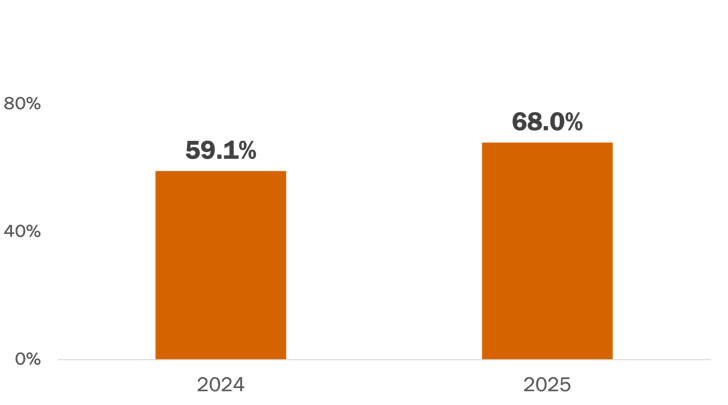
Percent proficient in math: Bentonville, grades 3 and 4
Percentage of students rated at Level 3 or Level 4 in ATLAS math assessment
(weighted average for grades 3 and 4)
The adoption followed a thorough and inclusive vetting process. "The teacher friendliness, the usability of Eureka Math² is what really made it rise to the top," Leandra Cleveland, elementary math specialist at Bentonville Schools, said. "It’s structured in a way the teacher can pick it up and look at a lesson and use it.”
High expectations and strong support
Cleveland recently spoke with several members of the Great Minds team. She said hard work by teachers and high expectations of them were behind the year-one progress. "We have high fidelity and usage expectations. I've recently had one or two others in the district say, 'But, really, what percentage of your teachers are actually using HQIM (high-quality instructional materials).' My answer is 100%. There's no question when I walk into a classroom, I’ll see Eureka Math² being used," Cleveland said.
That's not the case throughout the country. Many teachers use a mix of materials, even when they're provided with HQIM. "Here, we expect it. We've communicated it, and when we walk through their classrooms, we see that they’re using it," Cleveland added.
But Cleveland cautions others interested in learning from Bentonville's experience to recognize that curriculum requirements on teachers should come with strong support for them. "We’ve been reading about the implementation of HQIM with our administration, and we read this article recently that talked about how administrators have to give more than lip service to it. They’ve got to support teachers in answering questions they have. It can't just be telling them to use Eureka but should also include showing them what that looks like and offering to help," she said.
Another part of the district's success stems from having math coaches throughout schools. Cleveland says coaching is so important since today's high-quality math instruction typically looks different from the math instruction teachers themselves had or previously taught. For example, it emphasizes conceptual development and procedural fluency. That focus on conceptual development over rote memorization is new for many educators, Cleveland says.
Areas of focus
Arkansas leaders, like many around the country, are focused on ensuring struggling learners get the support they need and make up more ground this year. Cleveland said she believes the new math curriculum will help with that goal. She said embedded resources, such as UDL callout boxes in the teacher workbook, which are aimed at making the curriculum inclusive, are especially helpful.
The district is also emphasizing cognitively guided instruction, in which math teachers build on students' prior knowledge and emphasize intuitive approaches to problem solving by asking students questions, listening, and engaging with their thinking. Cleveland says pairing that with HQIM has resulted in more discussion, higher-order thinking, and better results in math class.
At the end of the day, Cleveland says she really credits Bentonville's teachers for helping students grow so much. She and other administrators have walked through classrooms on several occasions to assess how implementation was going. "They wanted to do their very best on day one, and they wanted students to do their best," Cleveland said.

Great Minds
Great Minds PBC is a public benefit corporation and a subsidiary of Great Minds, a nonprofit organization. A group of education leaders founded Great Minds® in 2007 to advocate for a more content-rich, comprehensive education for all children. In pursuit of that mission, Great Minds brings together teachers and scholars to create exemplary instructional materials that provide joyful rigor to learning, spark and reward curiosity, and impart knowledge with equal parts delight.
Topics: Case Study Adoption

Get the Latest Great Minds Updates
Stay informed of simple yet crucial implementation support tips, curriculum updates, new resources, professional development opportunities, and more for math, science, and ELA.

339e.jpg?width=430&name=PhD%20Science%20(1).jpg)
650a.jpg?width=430&name=EurekaMath%20(1).jpg)
8da0.jpg?width=430&name=WitWisdom%20(1).jpg)