



Math isn’t just about numbers—it’s also about language. One core belief behind Eureka Math²® California is that mathematical content, math practices, and language development are interconnected. The four domains of language—reading, writing, listening, speaking—must be considered when developing language-rich math instruction that is rooted in authentic discourse. Multilingual learners (MLLs) manage a heavy cognitive load as they process new mathematical understanding while simultaneously thinking about how they can communicate their ideas and results in English. To lighten the cognitive load placed on MLLs in math classrooms, Eureka Math² California embeds language supports that help these students balance all four domains of language when participating in and accessing rigorous, grade-level content.
Embedded Supports for Multilingual Learners
Integrating Math and Language Learning
Facilitating authentic mathematical discourse for MLLs is grounded in the belief that students can learn mathematics content at the same time they are learning the English used in math. Eureka Math² California lesson content draws students’ attention to important aspects of language (e.g., functions, structure, syntax, morphology), makes mathematical language accessible, and creates a classroom environment in which all students, including MLLs, feel comfortable taking risks, talking, and learning from one another.
Language Objectives in Every Lesson
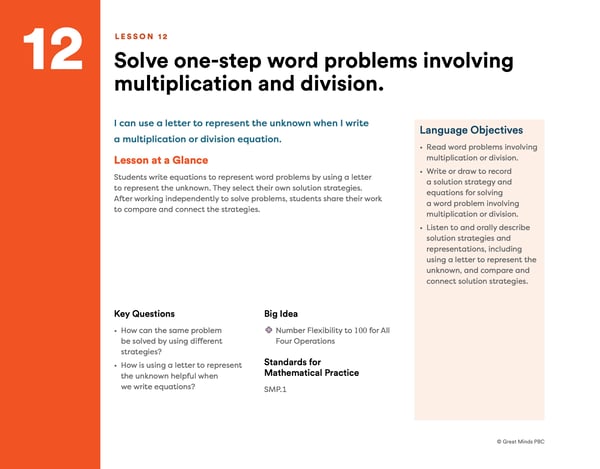
Eureka Math² California uses language objectives to support MLLs. Language objectives outline how to guide instruction using the four domains of language as they relate to the math objective of the lesson. The language objectives are developmentally appropriate and are responsive to the linguistic demands of mathematics. The objectives ensure that language development and math learning go hand in hand.
Targeted Instructional Recommendations
Another empowering embedded support in Eureka Math² California is the Multilingual Learner Support margin boxes, which provide targeted instructional recommendations at strategic points in the lesson. These supports include tailored sentence frames and sentence starters for math discussions that help students communicate in the moment for a specific activity within the lesson.
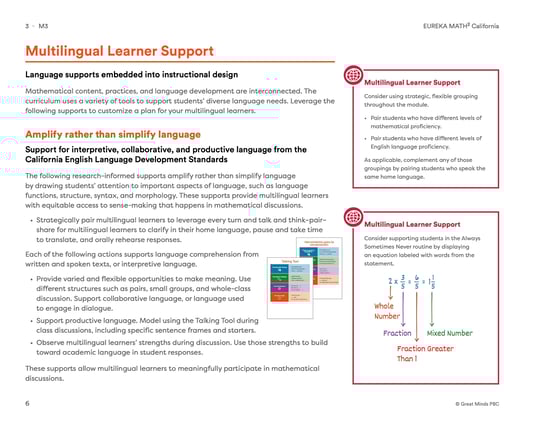
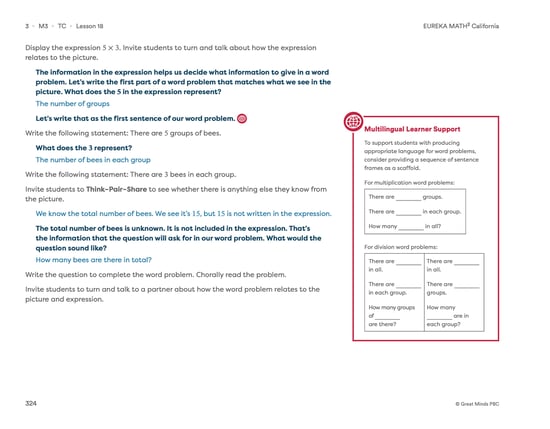
MLLs are more likely to use general sentence frames and sentence starters that can be applied to more than one activity when they encounter new and novel situations. Therefore, in addition to the Multilingual Learner Support boxes embedded throughout the lessons, a Talking Tool resource with general sentence frames is provided to help students explain their reasoning, ask questions, and interact respectfully with their peers. The Talking Tool is referred to in the Multilingual Learner Support margin boxes during times of sustained student-to-student discourse.
Strategic Grouping of Students

An all-encompassing Multilingual Learner Support margin box appears in the first lesson of every module. This margin box prompts teachers to consider using strategic, flexible grouping in each activity. Teachers are encouraged to strategically pair students with varying math and English language proficiencies, and when appropriate, pair students who share a home language. These student groups give MLLs a safe space to process, translate, and orally rehearse ideas before contributing within a broader classroom setting.
Mathematical Language Routines
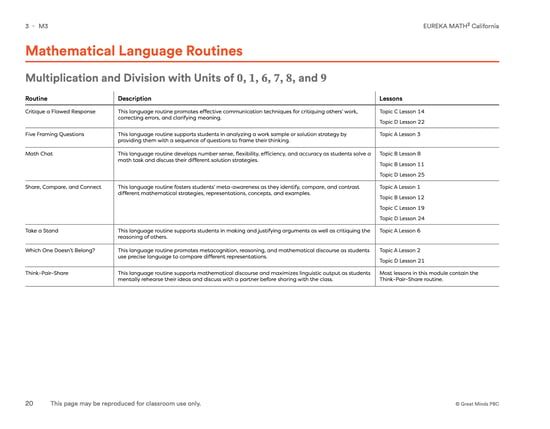 The Mathematical Language Routines (MLRs) are another vital embedded support. These structured, yet adaptable, strategies coupled with a supportive classroom community provide a predictable environment that promotes language development alongside math content in the following ways:
- Encourage students to speak, write, and share their reasoning
- Cultivate conversations by promoting peer dialogue that deepens understanding
- Support sense-making by highlighting key vocabulary, syntax, and academic phrases
- Foster meta-awareness by helping students reflect on how they use language to express mathematical ideas
Vocabulary Support
Alongside fostering mathematical discourse, students in language-rich classrooms must systematically develop an understanding of the terminology needed to communicate mathematical concepts. Educators must consider multiple tiers of terminology support at any one time—conversational, academic, and domain-specific. Eureka Math² California supports students by including
- multimodal strategies that pair math terms with images and manipulatives,
- academic verbs such as combine or approximate in context, and
- synonyms and student-friendly definitions for new terms before expecting students to use the terms independently.
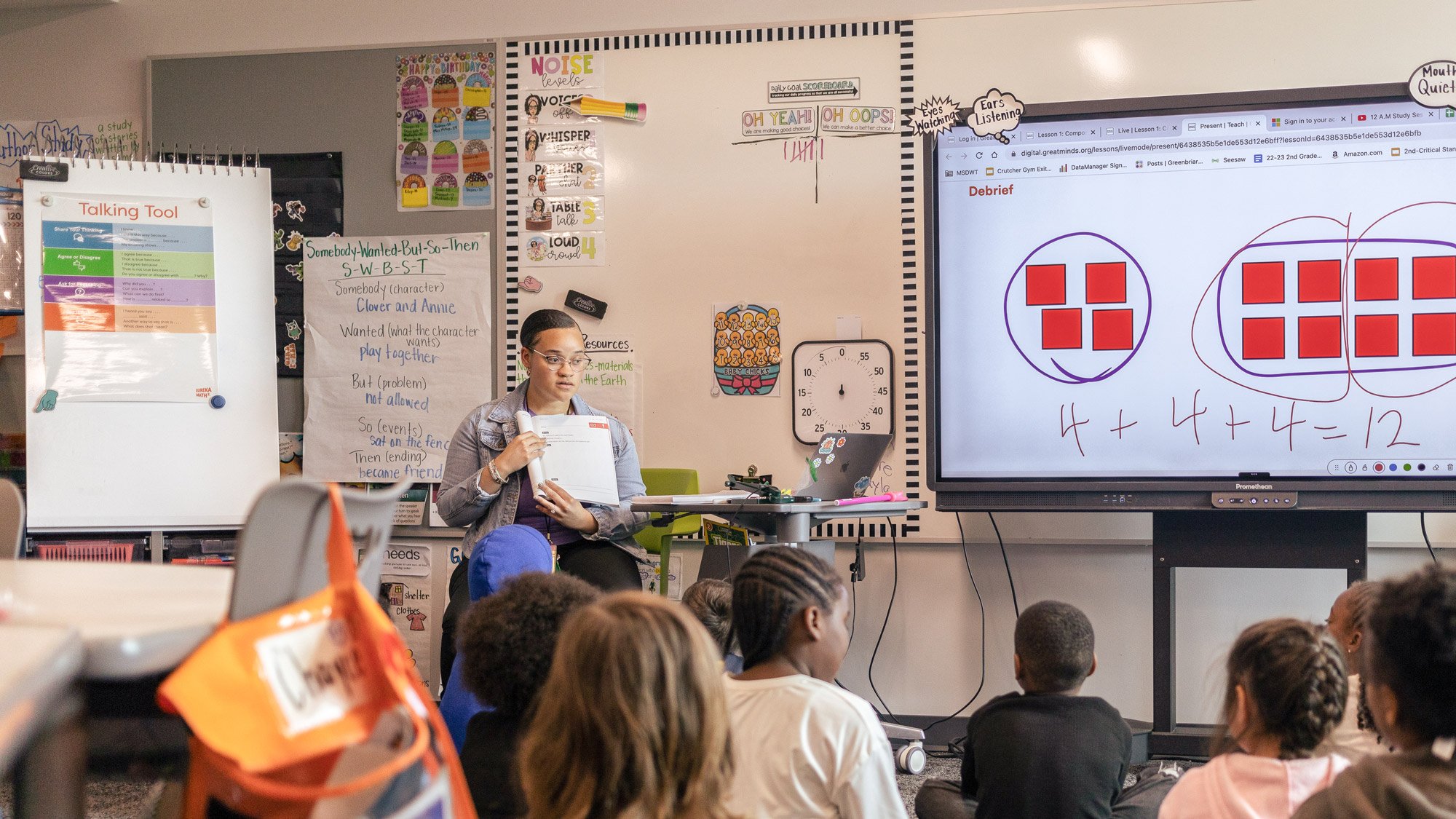
In addition to rich language development, Eureka Math² California lessons use clear, concise language that avoids unnecessary complexity while maintaining academic rigor. This attention to language enables MLLs to spend less time decoding dense language and more time focusing on mathematical ideas.
Equitable Curriculum Design:
Backed by Research
Asset-Based Instruction
Eureka Math² California wasn’t designed in isolation—it was informed by research about language acquisition and content learning. An asset-based instructional approach invites teachers to observe and build on students’ strengths by asking questions such as these:
- What do your students already bring to the instruction?
- How can you work with your students to connect their lived experiences, home languages, and cultural knowledge with the math they’re learning?
These same questions are at the heart of a curriculum that
- incorporates research-based strategies for teaching math to MLLs,
- sees every learner as capable and resourceful, and
- supports teachers in doing what they do best (that is, meeting students where they are and helping them move forward).
Math Curriculum That Uses Embedded Language Supports to Promote Growth
By weaving language supports into the structure of every lesson, math instruction becomes a language-rich environment in which every routine, discussion, and reflection provides an opportunity for growth. Educators can save time by not having to search for effective ways to differentiate or support language learning—the tools are already there, integrated seamlessly into each learning experience.
All students deserve to be full participants in a math classroom, from building conceptual math understanding and knowledge to being able to converse with their peers about math, share their experiences, and ask questions. Learn more about how Eureka Math2 California was designed to ensure that all students can be fully engaged learners in their classrooms.

Great Minds
Great Minds PBC is a public benefit corporation and a subsidiary of Great Minds, a nonprofit organization. A group of education leaders founded Great Minds® in 2007 to advocate for a more content-rich, comprehensive education for all children. In pursuit of that mission, Great Minds brings together teachers and scholars to create exemplary instructional materials that provide joyful rigor to learning, spark and reward curiosity, and impart knowledge with equal parts delight.

Get the Latest Great Minds Updates
Stay informed of simple yet crucial implementation support tips, curriculum updates, new resources, professional development opportunities, and more for math, science, and ELA.

339e.jpg?width=430&name=PhD%20Science%20(1).jpg)


650a.jpg?width=430&name=EurekaMath%20(1).jpg)
8da0.jpg?width=430&name=WitWisdom%20(1).jpg)